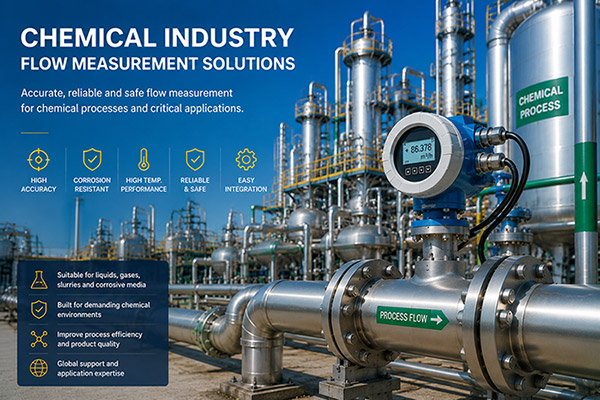
Chemical Flow Meter
Reliable flow measurement solutions for corrosive, aggressive and industrial chemical liquids.
Call Us: +61 406 563556
Chemical flow meters are designed to measure the flow rate of various chemical liquids in industrial processes. The correct flow meter selection depends on chemical properties, corrosion resistance, temperature, pressure and accuracy requirements.
Electromagnetic flow meters are commonly used for conductive chemical liquids, while ultrasonic and other technologies provide solutions for different process conditions.
A chemical flow meter measures the movement of liquid through a pipeline and converts the flow velocity into an electrical output signal.
For electromagnetic flow meters, Faraday's law of electromagnetic induction is used to measure conductive chemical liquids without moving parts or pressure loss.
Suitable materials such as PTFE lining, Hastelloy electrodes and stainless steel can be selected according to chemical media.
Provide stable measurement performance for chemical production and process control.
No moving parts design reduces maintenance requirements and improves reliability.
Chemical flow meters are widely used where accurate measurement and reliable operation are required for liquid chemical transportation and processing.
| Parameter | Consideration |
|---|---|
| Chemical Type | Corrosive, conductive or non-conductive liquids |
| Material | Lining and electrode material compatibility |
| Temperature | Process temperature requirements |
| Pressure | Working pressure and pipeline conditions |
| Output | 4-20mA, RS485, Modbus communication |
Yes. Electromagnetic flow meters can measure many conductive chemical liquids when proper materials are selected.
Common options include PTFE lining, rubber lining, 316 stainless steel and Hastelloy electrodes.
Consider chemical properties, temperature, pressure, pipe size and required accuracy.
Contact us for industrial chemical liquid flow measurement solutions.
Call Us: +61 406 563556